
Utilities Plus
A Houston utility concierge moved off WordPress and onto a site its own office runs — page copy, FAQs, providers, media, leads and traffic all editable in-house, with no developer in the loop.
Utilities Plus sets up a household's services before move-in day — electricity, internet and TV, smart security, gas and water, water filtration, moving services, home warranty, insurance referrals — through one rep, at no charge to the homeowner, earning from the providers instead. The old site was a stock WordPress build on Astra and Elementor: slow, generic, and indistinguishable from a thousand other home-services templates. Two audiences use the site for opposite reasons. A homeowner arrives stressed and three weeks from a move, wanting to know this is real and free. A real-estate agent arrives evaluating whether to hand clients over, wanting to know it will not embarrass them. One page cannot serve both, and a bullet list of eight services serves neither. The rebuild solved that. What it did not solve was the reason people leave WordPress and then miss it: every copy change, every new FAQ, every provider logo came back to us.
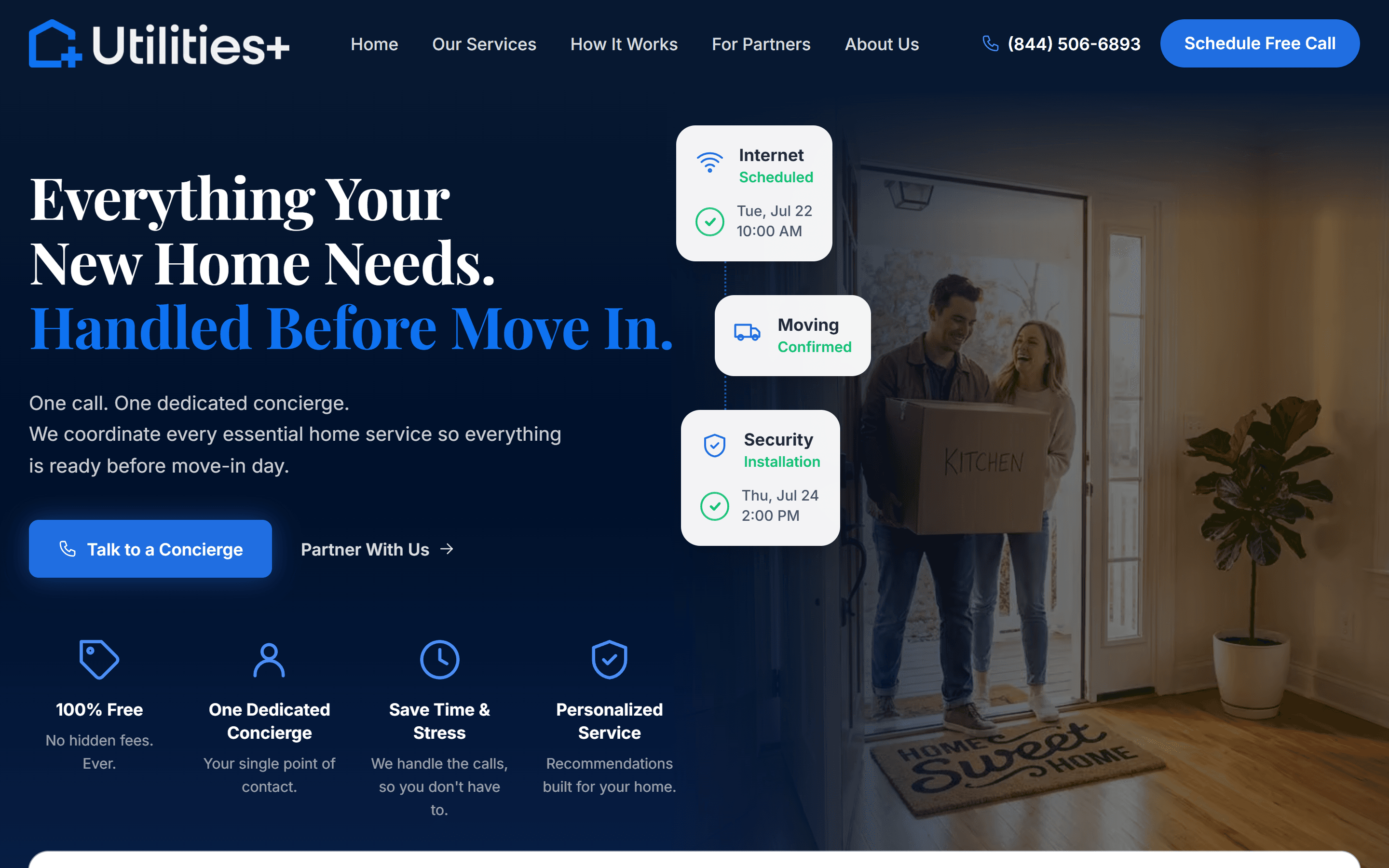
The homepage answers the homeowner in one line — everything your new home needs, handled before move in — and then shows it rather than describing it. Floating beside the photograph are the cards a customer would actually receive: internet scheduled Tuesday at ten, movers confirmed, security installation Thursday at two. That is the product. Everything below it is the explanation. The order is deliberate. How it works comes first, the eight services second, the partner pitch third, because a stressed homeowner three weeks from a move needs to understand the process before a menu means anything. "100% free, no hidden fees, ever" sits in the benefits row, since the first question anyone asks about a free concierge is where the catch is. Agents get their own route into the same operation instead of a paragraph aimed at somebody else. Inter for reading, Playfair Display for headlines, with the decorative face deliberately kept off the critical render path so the type it sets is not what people wait for. Provider names do the work that adjectives usually get asked to do. Reliant, Xfinity, Frontier, ADT, Vivint — a homeowner recognises the companies and stops wondering whether this is a real service. That is worth more than another sentence about being trusted. Then the site was given a back office. Page copy, FAQs, providers and media all moved into Postgres behind an admin panel, so the content on the public pages is data the client owns rather than markup only a developer can reach.
The surface area we built.
Off WordPress, onto their own stack
The Astra and Elementor build replaced with hand-written components, every old slug redirected, and the full Mako baseline underneath: HSTS preload, a real CSP, locked Permissions-Policy, no server fingerprint, sitemap, robots and llms.txt.
A content panel the office actually uses
Page copy, FAQs, providers and a media library all live in Postgres and are edited in the admin. The public pages read from the same rows, so a change is live when they save it — the thing WordPress was doing for them, without WordPress.
Leads worked in an inbox, not an inbox
Submissions land in a database and are read, opened and tracked in the panel rather than scattered across a mailbox. Turnstile on the forms, rate limiting on the endpoints, and the record written before the notification is attempted so a mail failure cannot lose an enquiry.
Their own analytics, not a third party's
Page views, events and Core Web Vitals collected in-house and read in the panel, with background-tab and bfcache samples dropped rather than capped so the vitals reflect what visitors experienced. Connected to the Mako control panel, where it reported 1,047 views and 839 sessions on the day it was wired up.
Real providers, named
Reliant, Xfinity, Frontier, ADT and Vivint appear as the companies behind the service, managed as records rather than hardcoded logos. The fastest way to prove a free concierge is legitimate is to show whose services it connects.
Two audiences, two routes
Homeowners get how-it-works and the eight services; real-estate agents get a partner track of their own. Fifteen questions grouped by who is asking, in ARIA-correct accordions with FAQPage schema, plus Organization, PostalAddress and WebSite structured data across the site.
Admin nobody can walk into
iron-session with TOTP two-factor, recovery codes, rate-limited attempts, and a bot check that fails open rather than locking a real person out of their own panel — a bug found and fixed after a blocked check did exactly that.
Live at utilities-plus.com and no longer dependent on us for day-to-day changes. The client edits their own copy, FAQs, providers and media, works their own leads, and reads their own traffic; error capture and the fleet control panel keep the parts they should not have to think about visible on our side.
Want something like this?
We ship premium sites fast — AI-native, end-to-end, signed where it matters.